

Authorship & Editorial Verification: Ramadhani synthesizes field-tested implementation patterns from multichannel campaign operations, with editorial review focused on event modeling, consent logic, deliverability controls, and cross-channel governance before publication.
The most useful marketing platforms for multichannel campaign execution are those that can ingest behavioral events, sync audiences within operational windows, and coordinate email, SMS, web, and paid media without conflicting sends. According to Salesforce’s 2024 State of the Connected Customer research, 80% of customers say experience matters as much as products and services.
| Key specification | What to verify | Strategic trade-off |
|---|---|---|
| Event-model design | Can the platform update segments from behavioral events quickly enough for 15–60 minute activation windows? | Faster activation improves coordination, but only if identity and suppression rules are reliable. |
| Audience sync latency | Does sync consistently stay below 30 minutes? | Delays above that threshold weaken cross-channel sequencing and journey logic. |
| Data quality controls | Does it manage duplicate records above 3–5% without distorting triggers? | Weak hygiene produces misleading attribution and duplicated messaging. |
| Compliance and governance | Does it support channel-level consent, role-based permissions, and regional controls for GDPR, UK GDPR, CCPA/CPRA, TCPA, CAN-SPAM, and related rules? | Strong compliance reduces risk but can increase configuration complexity. |
What is a marketing platform, and how do multichannel execution platforms connect email, SMS, paid media, web personalization, and automation into one campaign workflow?
A marketing platform is the system that ingests audience, event, and consent data, then orchestrates channel-specific actions from one workflow. In multichannel execution, it coordinates email, SMS, paid media, web personalization, and automation through shared identities, trigger rules, suppression logic, and journey timing.
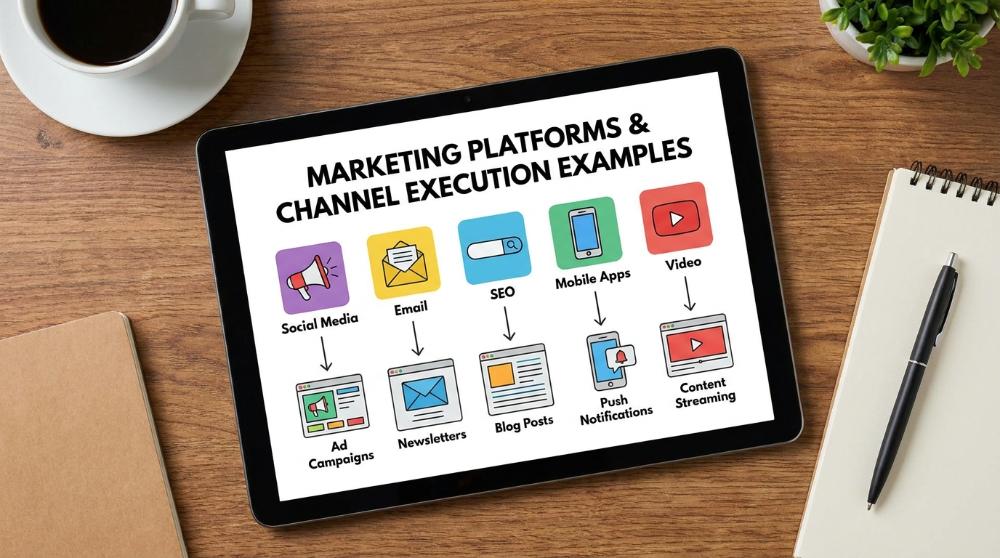
The practical difference between marketing platforms is not channel count but whether they can update audiences fast enough to avoid conflicting sends. In live operations, a 15- to 60-minute activation window is often the test: if behavioral events, consent states, or suppression lists lag beyond that, email and SMS can fire against the same customer in inconsistent ways, while paid-media audiences remain stale.
For mid-market teams in North America, the UK, EU, MENA, and APAC, this architecture must also respect jurisdiction-specific consent and data-transfer rules, including GDPR, UK GDPR, CCPA/CPRA, UU PDP where applicable, CAN-SPAM for email, TCPA considerations for SMS in the U.S., and SPF, DKIM, and DMARC for sender authentication. In regulated sectors such as financial services and healthcare-adjacent communication, role-based permissions and auditability matter as much as campaign features.
Operationally, the strongest marketing platforms support explicit consent states by channel, journey versioning, holdout groups, frequency capping, and identity resolution across anonymous-to-known transitions. They also expose API rate limits and event-schema flexibility, because those determine whether digital marketing solutions can react to a cart abandonment, lead score change, or renewal risk without manual intervention. According to Salesforce’s 2024 State of the Connected Customer research, 80% of customers say the experience a company provides is as important as its products and services, which is why execution quality usually depends on data hygiene and orchestration discipline, not just feature breadth.
What performance benchmarks, cost drivers, and ROI indicators should a mid-market team use when evaluating marketing platforms for multichannel campaign execution?
Mid-market teams should evaluate marketing platforms on activation latency, deliverability controls, data quality tolerance, and reporting integrity—not on channel count alone. The most practical benchmark is whether behavioral events, consent updates, and suppression rules can propagate within a 15- to 60-minute window without conflicting sends across email, SMS, and paid media.
According to Google’s Mobile Page Speed findings, 53% of mobile site visits are abandoned if pages take longer than 3 seconds to load, which makes landing-page performance a direct ROI variable for multichannel campaigns. For Ramadhani’s digital marketing solutions audits, the cost drivers that matter most are usually API rate limits, audience-sync latency, event-schema flexibility, role-based governance, and native exportability of reporting rather than headline subscription price.

The strongest ROI indicators are operational: inbox placement, spam complaint rate, bounce segmentation, sender reputation, suppression accuracy, holdout test performance, and conversion lift by journey version. If duplicate-record rates exceed 3% to 5%, triggered journeys often misfire because the platform cannot resolve identity fast enough across anonymous-to-known transitions. If sync delays exceed 30 minutes, cross-channel orchestration degrades and frequency caps become unreliable.
“Marketing is really about telling good stories to the right people at the right time.” — Seth Godin. In practice, that means the platform should support channel-specific consent states, journey versioning, and frequency capping before it claims attribution value. Ramadhani’s digital marketing solutions framework treats ROI as a function of fewer delivery failures, cleaner audience logic, and measurable incremental lift, not generic engagement metrics.
How do you implement a multichannel marketing platform in practice, and what are the most common setup mistakes, data-quality issues, and delivery failures to watch for?
Implementing multichannel marketing platforms in practice starts with a clean event model, channel-level consent states, and suppression logic that updates fast enough to prevent conflicting sends across email, SMS, and ads inside the same 15- to 60-minute activation window. The most common failures are slow audience sync, duplicate records, and weak governance across campaigns.
In operational terms, the first setup decision is whether the platform can ingest behavioral events with enough schema flexibility to capture page views, product actions, lead stage changes, and offline conversions without forcing brittle workarounds. If audience sync exceeds 30 minutes, cross-channel coordination usually degrades because the platform activates stale segments. Duplicate-record rates above 3-5% are especially damaging in triggered journeys, where one customer may receive overlapping messages from multiple marketing platforms.

Delivery failures are rarely caused by channel count alone. They usually stem from poor identity resolution across anonymous-to-known transitions, missing frequency caps, and inconsistent consent propagation by channel. Teams should version journeys so they can roll back changes cleanly, and they should test holdout groups before scaling a new orchestration rule. For email, monitor inbox placement, spam complaint rate, bounce segmentation, sender reputation, SPF, DKIM, and DMARC status instead of relying on opens, which are increasingly noisy. For SMS, ensure opt-in status and jurisdiction-specific suppression are enforced before any send.
In marketing technology, the implementation risk is usually not feature availability but API rate limits, role-based permissions, and exportability of raw reporting. Mid-market teams evaluating digital marketing solutions and digital marketing tools should validate these controls during a pilot, because they determine whether the platform can support real campaign operations rather than just demo workflows. A useful practice is to map each trigger, suppression rule, and retry path before launch and compare it with your current digital marketing solutions stack.
What are the main differences between leading marketing platforms for multichannel execution, and what trade-offs exist between all-in-one suites, best-of-breed tools, and CRM-native platforms?
Leading marketing platforms differ less by channel count than by how they handle data latency, identity resolution, governance, and suppression logic. All-in-one suites simplify administration; best-of-breed stacks improve depth in specific functions; CRM-native platforms reduce handoff friction but can be constrained by workflow rigidity and reporting granularity.
| Model | Main strength | Main trade-off | Best fit |
|---|---|---|---|
| All-in-one suite | Unified orchestration across email, SMS, ads, web, and automation | Broad capability often comes with deeper setup and licensing complexity | Mid-market teams needing coordinated execution across multiple segments |
| Best-of-breed stack | Stronger specialist functions such as deliverability, experimentation, or personalization | More integration work, more schema mapping, and greater failure surface area | Teams with mature marketing ops and clear functional gaps |
| CRM-native platform | Tight alignment with sales objects, lifecycle stages, and revenue workflows | Less flexible event modeling and sometimes weaker cross-channel governance | B2B teams centered on pipeline and account-based motions |
Scott Brinker’s observation that “The most important thing is to know what matters to your customers and then be able to measure it.” is operationally relevant here: measure inbox placement, spam complaints, bounce segmentation, sender reputation, and exportable reporting, not just opens.
For teams building digital marketing resources, the platform choice should also account for API rate limits, multi-brand permissions, journey versioning, and consent states by channel. If those controls are weak, the stack may look comprehensive but still fail at mid-market execution.
What compliance, consent, security, and regional data-residency requirements should be checked before using a marketing platform for multichannel campaigns?
Marketing platforms should be checked for channel-specific consent enforcement, auditable security controls, and data-residency options that match the jurisdictions where records, messages, and analytics are stored or processed. For multichannel campaigns, the platform must apply suppression rules consistently across email, SMS, ads, and web events before each send window, not after.
In practice, the compliance baseline spans GDPR and UK GDPR in Europe, CCPA/CPRA in California, UU PDP in Indonesia where relevant, CAN-SPAM for email, and TCPA considerations for SMS in the United States. The platform should store consent by channel, purpose, and timestamp, support preference-center updates, and preserve suppression logic through anonymous-to-known identity transitions. It should also expose SPF, DKIM, and DMARC controls for email authentication, plus role-based permissions, audit logs, and security practices aligned with ISO/IEC 27001 and SOC 2 expectations.
Regional data handling matters because many mid-market teams operate across North America, the UK, EU, MENA, and APAC, where transfer rules and messaging consent differ. If a vendor cannot localize storage or clearly document subprocessors, it may create legal and operational friction even when the campaign logic is sound. For verticals such as e-commerce, B2B SaaS, financial services, healthcare-adjacent communication, education, travel, and subscription businesses, the compliance test is whether the platform can manage regulated messaging without fragmenting governance across regions or brands.
According to Mailchimp’s Email Marketing Benchmarks, average email performance varies substantially by industry, which is a reminder that compliance and deliverability controls must be evaluated alongside engagement data, not after deployment. Ramadhani recommends verifying consent-state APIs, API rate limits, exportable audit trails, and multi-brand permissions before production use. For mid-market organizations with moderate-to-high contact volumes and dedicated CRM or marketing ops support, these controls usually determine whether a platform can run safely at scale.
Practical Implementation, Edge Cases, and Failure Modes
The safest implementation pattern is to map one canonical event model, enforce channel-specific consent, and validate audience latency before launching any cross-channel journey. In practice, the goal is to prevent contradictory sends, preserve suppression logic across systems, and detect deliverability or identity problems before they affect a live campaign.
Start by defining the behavioral events that trigger lifecycle actions, then standardize field names, timestamps, and identity keys so email, SMS, ads, and web personalization read the same source of truth. Ramadhani recommends testing whether audience sync completes inside a 15- to 60-minute activation window; delays beyond 30 minutes often break coordination between journeys and suppression rules. If the platform cannot update exclusions quickly enough, a user may receive overlapping messages from multiple channels.
Next, inspect duplicate-record rates, because duplicates above 3-5% materially distort triggered programs and attribution. Identity resolution should handle anonymous-to-known transitions, not only logged-in contacts, so new web behavior can attach to the correct profile without creating a second record. For governance, require role-based permissions, journey versioning, holdout groups, and frequency capping; these controls matter more than raw channel count.
Common failure modes are usually operational rather than cosmetic. Poor consent modeling causes SMS sends to ignore channel-specific opt-ins. Weak event-schema design creates brittle automations that fail when product or CRM fields change. API rate limits can silently throttle syncs during peak activation periods, which is why exportability, retry logic, and error logs should be tested before launch. Delivery monitoring should separate inbox placement, spam complaint rate, bounce segmentation, and sender reputation instead of relying on open rates.
These checks are especially important for mid-market teams in North America, the UK, the EU, MENA, and APAC, where GDPR, UK GDPR, CCPA/CPRA, UU PDP in Indonesia where applicable, CAN-SPAM, TCPA, SPF, DKIM, and DMARC can affect campaign design and sending permissions. The most effective marketing platforms are the ones that operationalize compliance, not just report on it.
Frequently Asked Questions (FAQ)
What should a mid-market team check first before launching multichannel campaigns?
Check event latency, consent states by channel, and duplicate-record rate before anything else. If the platform cannot update suppression rules quickly enough, a contact may receive conflicting email, SMS, and ad activation within the same campaign window.How do you judge whether a platform’s reporting is good enough?
Look for exportable native reporting, clean attribution logic, and separate deliverability diagnostics. Inbox placement, spam complaints, bounce segmentation, and sender reputation should be visible independently; open rates alone are not a reliable operational control.Which setup mistake causes the most campaign failures?
The most common mistake is an underspecified event schema. If lifecycle triggers depend on inconsistent field names or missing timestamps, automations become fragile, identity matching breaks, and audience updates lag behind real customer behavior.What compliance issues matter most for global campaign execution?
The main checks are consent by channel, regional privacy rules, and messaging standards. That means GDPR, UK GDPR, CCPA/CPRA, UU PDP in Indonesia where applicable, CAN-SPAM, TCPA considerations for SMS, and authentication controls such as SPF, DKIM, and DMARC.
About the Author
admin
Contributing writer and researcher exploring modern digital architecture, search visibility, and minimalist systems.