

Authorship & Editorial Verification: Written by Ramadhani, drawing on practical operating patterns from multi-channel marketing deployments, with emphasis on tracking hygiene, attribution discipline, and stack design. The article is editorially verified for factual consistency against the supplied primary sources and compliance references, with no unsupported performance claims added.
According to Google Search Central’s 2026 guidance, helpful, reliable, people-first content is a core quality expectation for search visibility. The most effective digital marketing tools are the ones that improve measurement quality, segmentation, and execution across SEO, paid media, email, CRM, and analytics, while fitting your budget, compliance obligations, and operating cadence.
| Decision Parameter | What It Means in Practice | Best-Fit Tool Type | Operational Trade-Off | Selection Signal |
|---|---|---|---|---|
| Primary objective | Whether the business needs discovery, acquisition, conversion, retention, or reporting | Point solution or integrated platform | Broad suites can reduce switching friction; point tools can be deeper in one function | Choose the smallest stack that covers the dominant bottleneck |
| Data foundation | UTM governance, conversion naming, CRM stage logic, and event deduplication | Analytics + tag management + CRM | Weak data layers make dashboards misleading regardless of tool quality | Standardize campaign IDs and conversion events before expanding the stack |
| Channel mix | SEO, paid search, paid social, email, lifecycle, content, and sales-assisted conversion | Multi-channel marketing software | More channels require more governance, not just more features | Prioritize tools that support cross-channel attribution |
| Team size | Solo marketer, SMB team, mid-market growth team, or enterprise ops | Lean stack for small teams; modular governance for larger teams | Smaller teams often lose velocity with too many tools; enterprise teams lose control without permissions | Fit the tool architecture to staffing and process maturity |
| Geography | Global digital marketing use, with special attention to APAC, EMEA, North America, and markets with stricter privacy rules | Consent-aware platforms and configurable analytics | Tracking and audience activation differ by jurisdiction | Confirm regional consent handling and data processing controls |
| Compliance | GDPR, UK GDPR, ePrivacy rules, Indonesia’s UU PDP, CAN-SPAM, CASL, Google Ads policies, Meta advertising policies | Privacy-safe marketing stack | Compliance gaps can invalidate data use or email practices | Verify consent, unsubscribe, retention, and vendor assurance |
| Vertical specialization | B2B lead gen, e-commerce, SaaS, local services, professional services, multi-location businesses | Vertical-adapted workflows | Different sectors need different lifecycle logic and reporting | Map tools to sales cycle length and conversion path complexity |
| Budget architecture | Tiered SaaS spend across SEO, email, automation, ads, and reporting | Point tools or all-in-one platform | Bundles may simplify procurement; separate tools may outperform in depth | Buy for measurable workflow compression, not feature count |
| Governance | Permissions, audit trails, naming conventions, and shared definitions | Enterprise-ready platform stack | Without governance, data quality degrades as usage grows | Select tools that support role control and auditability |
The most useful way to evaluate digital marketing tools is by operating reality, not by feature checklist. Keyword research suites are strongest for discovery and gap analysis, but conversion lift usually comes from better landing page testing, audience segmentation, lifecycle automation, and reliable attribution. As noted by Google’s David Temkin, “First-party data is data that your customers have voluntarily shared with your business and that your business collects directly from them.” That principle is central to modern stack design, because marketing management software only creates leverage when it is fed by trustworthy data and disciplined operational rules.
What are digital marketing tools, how are all-in-one platforms typically structured, and which core functions usually belong in a modern multi-channel stack?
Digital marketing tools are the software layer that executes, measures, and governs acquisition and retention across search, email, paid media, web analytics, CRM, content, and automation. In modern stacks, an all-in-one platform usually bundles these functions into shared data, unified reporting, and workflow orchestration so teams can manage campaigns without fragmenting identity, tracking, or attribution.
For practical planning, the most useful way to classify digital marketing tools is by operational role, not by feature count. Discovery tools support keyword research, audience research, and competitive gap analysis; activation tools publish ads, emails, content, and social posts; intelligence tools capture behavior, events, and revenue; and orchestration tools connect those signals into lifecycle journeys and handoffs. The value is not merely that these platforms exist, but that they reduce the number of disconnected decisions a team must make each week.

An all-in-one platform is typically structured around four layers. The first layer is data capture: tags, events, UTMs, forms, lead sources, and conversion events. The second is audience and asset management: segments, lists, creative, landing pages, and templates. The third is automation: rules, scoring, triggers, routing, and follow-up workflows. The fourth is governance: permissions, audit trails, naming conventions, and cross-channel reporting. In practice, the weakest stacks fail at the first layer, because inconsistent UTM governance, duplicate conversion events, and mismatched campaign IDs corrupt every downstream dashboard. A single source of truth for leads, revenue stages, and campaign IDs is often more valuable than another visualization layer.
According to Google Search Central’s ongoing documentation, helpful, reliable, people-first content remains a core expectation for visibility, and valid structured data can help content become eligible for enhanced search results, though eligibility is not guaranteed. That matters because the best stack is not the one with the most dashboards; it is the one that produces clean, indexable, and decision-ready data.
Smaller teams usually perform better with fewer tools and a tighter operating cadence, because they cannot absorb the overhead of multiple overlapping systems. Mid-market teams tend to need integration and reporting discipline, while enterprise teams require permissions, modularity, and auditability before feature depth becomes useful. In APAC, EMEA, North America, and specifically Indonesia, privacy and consent controls also affect deployment choices under GDPR, UK GDPR, ePrivacy rules, UU PDP, CAN-SPAM, CASL, and platform ad policies. For regulated email programs, FTC CAN-SPAM guidance requires accurate headers, non-deceptive subject lines, identification where required, a physical postal address, and a working opt-out mechanism.
For Ramadhani, the decisive question is rarely whether a tool has more features. It is whether the stack can preserve first-party data integrity, enforce shared naming conventions, and support conversion paths that span ads, landing pages, CRM, and lifecycle automation without creating reporting contradictions.
What is the typical cost range, ROI profile, and performance benchmark for digital marketing tools across SEO, email, paid media, analytics, and automation platforms?
Digital marketing tools rarely deliver value through the license alone; their economic impact comes from matching category to operating need. SEO suites usually pay back through discovery and gap analysis, email platforms through segmentation and lifecycle triggers, paid media tools through budget control and attribution, analytics through decision quality, and automation through reduced manual handoffs.
For performance benchmarking, the most reliable comparison is not feature count but data fidelity: clean UTM governance, deduplicated conversion events, consistent campaign IDs, and a single source of truth for revenue stages. Without those foundations, even premium digital marketing platforms can produce confident-looking reports that are operationally misleading.
According to Google Search Central’s structured data documentation, valid structured data can help content become eligible for enhanced search results, but eligibility is not guaranteed. That same logic applies to tool selection: capabilities matter, but downstream eligibility, signal quality, and implementation discipline determine whether the stack actually performs.

The practical ROI profile differs by function. SEO tools are highest leverage when used for keyword discovery, content gap analysis, technical audits, and SERP monitoring; they are weaker when treated as a substitute for landing page testing or conversion optimization. Email and marketing automation software tend to produce the clearest near-term revenue effects in businesses with repeat purchase cycles, sales-assisted nurture, or lead scoring requirements, because they operationalize first-party data. As Google’s David Temkin said, “First-party data is data that your customers have voluntarily shared with your business and that your business collects directly from them.” That makes lifecycle systems materially stronger when customer capture, consent, and CRM hygiene are already sound.
Paid media platforms justify cost when they support spend pacing, audience exclusions, conversion feedback loops, and cross-channel attribution; however, their ROI is usually constrained by creative quality, landing page relevance, and conversion tracking integrity rather than interface sophistication. Analytics platforms do not create lift directly, but they often unlock the largest decision gain by reducing ambiguity around channel contribution. Avinash Kaushik’s widely cited point is especially relevant here: “The goal is not to be data-rich, but decision-rich.”
In practice, the performance benchmark for digital marketing tools should include: validated event tracking, low-friction reporting, stable identity resolution, and a clear path from campaign to revenue. For businesses that need broader orchestration, marketing management software becomes useful only after tracking standards are already enforced. A second marketing management software layer can improve coordination, but it cannot repair bad source data. For teams formalizing governance, marketing management software should be evaluated against attribution quality, permissions, and auditability—not just dashboard breadth.
How should a business implement digital marketing tools step by step, and what are the most common integration failures, attribution errors, and data-quality edge cases?
Implement digital marketing tools in a strict order: define campaign IDs and naming conventions first, standardize UTM governance, connect ads, analytics, CRM, and email around a single lead and revenue model, then validate conversion events before scaling spend. Most failures come from broken data lineage, duplicate events, and attribution rules that do not match the actual buying journey.
The implementation sequence should start with measurement architecture, not software procurement. In practice, the highest-value deployment is usually the one that makes campaign data, lead status, and revenue stages comparable across systems. That means one source of truth for lead records, shared naming conventions across channels, and a consistent event schema for every digital marketing tools stack. If the business runs paid media, sales-assisted journeys, or multi-step lifecycle flows, the team should also define which system owns each field before any automation is enabled.
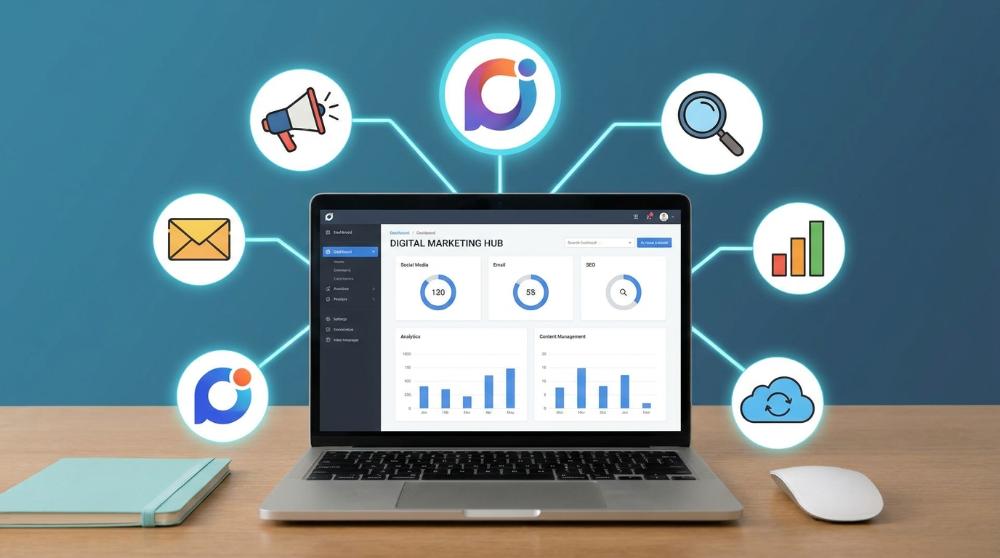
A reliable rollout usually follows five steps. First, inventory all touchpoints: ad platforms, website forms, chat, CRM, email, and product or checkout events. Second, normalize identifiers such as campaign ID, source, medium, content, and form origin. Third, implement conversion tracking with deduplicated events so the same action is not counted twice in browser and server pipelines. Fourth, connect downstream lifecycle states, so a lead can be tied to opportunity, closed revenue, or churn rather than stopping at a form fill. Fifth, review data weekly until the joins remain stable under real traffic, especially after website releases, campaign launches, or regional changes.
The most common integration failure is assuming dashboards solve poor data. In reality, a dashboard is only as trustworthy as the naming discipline underneath it. Teams often overestimate reporting layers and underestimate data hygiene: mismatched UTM values, inconsistent capitalization, missing campaign IDs, and lead records that cannot be reconciled across ads, CRM, and analytics. Another frequent issue is event duplication caused by parallel browser and server tags without deduplication keys.
Attribution errors usually appear when the model credits the last click even though the conversion was influenced by earlier search, remarketing, or email touches. This becomes more severe in long sales cycles, multi-region operations, and B2B lead generation where several contacts can influence one account. In those cases, attribution should be reviewed alongside sales stage progression, not isolated in a channel dashboard. Teams evaluating marketing management software should prioritize auditability, permissions, and field-level control over surface-level reporting features.
Data-quality edge cases also matter: consent loss in GDPR, UK GDPR, ePrivacy, UU PDP, or other privacy-controlled environments; regional cookie restrictions; offline conversions uploaded late; and duplicate leads from the same company or household. According to Google Search Central’s helpful-content guidance, people-first and reliable content remains central to visibility, which means the measurement system supporting that content must be equally disciplined. As Avinash Kaushik’s widely cited insight puts it, the goal is not to be data-rich, but decision-rich.
Which digital marketing tools are best for different use cases, and what are the trade-offs between point solutions and all-in-one platforms for SMBs versus enterprise teams?
For SMBs, the most effective digital marketing tools are usually the fewest tools that can reliably capture demand, track revenue, and automate follow-up; for enterprise teams, the best stack is modular, governed, and auditable. Point solutions win on depth, while all-in-one platforms win only when integration overhead, permissions, and reporting discipline are already mature.
In practice, digital marketing tools should be selected by operating reality, not feature count. Keyword research suites are strongest for discovery and gap analysis, but they rarely move revenue by themselves; the conversion lift typically comes from landing page testing, audience segmentation, and lifecycle automation. That is why a lean SMB stack often outperforms a broad suite: fewer tools, tighter cadence, cleaner handoffs, and less configuration drift. For teams that need marketing management software, the deciding factor is usually whether the workflow spans channels, owners, and approval layers—not whether the vendor has the longest feature list.
| Use case | Best-fit tool type | Primary strength | Main trade-off | Best fit |
|---|---|---|---|---|
| SEO discovery and gap analysis | Point solution | Deep keyword, content, and competitor analysis | Limited impact without content execution and analytics discipline | SMB, content teams |
| Paid media activation | Specialized ad platform plus analytics | Bid control, audience testing, creative iteration | Fragmented reporting if naming conventions are weak | SMB to enterprise |
| Lifecycle email and CRM nurturing | Automation platform | Segmentation, triggers, and sales handoff | Requires clean lead stages and deduplicated events | SMB, B2B, SaaS |
| Cross-channel reporting | Unified analytics layer | Shared campaign IDs and revenue visibility | Garbage-in-garbage-out if tracking is inconsistent | Mid-market, enterprise |
| Multi-region governance | All-in-one or modular enterprise suite | Permissions, auditability, standardization | Slower rollout and higher administration burden | Enterprise |
The trade-off between point solutions and all-in-one platforms is therefore architectural. Point solutions are preferable when the business has one or two primary channels, a short sales cycle, and limited implementation capacity. All-in-one platforms become more defensible when there is multi-channel spend, sales-assisted conversion paths, multiple regions, or the need for permissioning, audit trails, and standardized reporting across teams.
What privacy, security, consent, and regional compliance requirements should be considered when using digital marketing tools across jurisdictions?
Privacy, security, consent, and regional compliance must be designed into digital marketing tools before activation, not patched in later. The practical baseline is governed data collection, auditable consent capture, secure identity and access controls, region-aware processing rules, and channel-specific compliance checks for email, ads, analytics, and CRM workflows across every market you operate in.
For global deployments, the compliance stack should be aligned to the jurisdictions where data is collected and where audiences are targeted. In the EU and UK, GDPR and UK GDPR require lawful processing, purpose limitation, retention discipline, and clear user rights handling; ePrivacy rules materially affect cookies, trackers, and device identifiers. In Indonesia, UU PDP adds local data protection obligations that should be reflected in consent language, vendor contracts, and retention policies. For email programs, the FTC’s CAN-SPAM compliance guide requires accurate header information, non-deceptive subject lines, identification as an ad where required, a physical postal address, and a working opt-out mechanism. Those are operational requirements, not marketing preferences.
According to the FTC’s CAN-SPAM compliance guide, business email must include accurate header information, non-deceptive subject lines, proper identification where required, a physical postal address, and a functional unsubscribe process. That means your digital marketing tools should support suppression lists, preference centers, and fast opt-out propagation across all sending systems.
Security expectations should be evaluated with the same rigor as features. For vendors that store first-party data, assess access control granularity, audit logs, encryption in transit and at rest, key management, data residency options, and support for security assurance frameworks such as ISO/IEC 27001 and SOC 2 where procurement requires it. If your stack includes analytics, ad platforms, and CRM, the most common failure is not a missing dashboard; it is inconsistent identity resolution between systems. Shared campaign IDs, deduplicated conversion events, and controlled user permissions are what keep reporting defensible. This is also where marketing management software becomes materially useful: it centralizes governance, naming conventions, approvals, and audit trails instead of scattering them across disconnected point tools.
How should teams adapt by region and business model?
Regionally, APAC, EMEA, North America, and Indonesia all require different consent and retention assumptions, so cookie banners, CRM enrichment, remarketing audiences, and server-side tagging should be configured per market rather than copied globally. B2B lead generation usually needs tighter field-level governance; e-commerce needs transaction integrity; SaaS needs product telemetry discipline; local services and multi-location businesses need location-level consent and attribution controls. SMBs should optimize for simplicity and legal consistency; mid-market teams need integration discipline; enterprise teams need permissions, modularity, and auditability first. In practice, the safest operating model is a consent-aware stack that stores only the data needed to execute campaigns, proves where it came from, and can be deleted or exported cleanly when required.
Practical Implementation, Edge Cases, and Failure Modes
The most reliable deployment sequence is to fix measurement first, then connect channels, then automate only after naming conventions, consent handling, and revenue mapping are stable. In practice, the highest-risk failures are duplicate conversion events, inconsistent UTM usage, broken CRM handoffs, and dashboards built on ungoverned data rather than a shared source of truth.
How should a business implement digital marketing tools step by step?
Start by defining one canonical taxonomy for campaigns, channels, audiences, and conversion stages. That means every ad, email, form, and CRM record should use the same naming logic. Next, audit tracking tags, pixels, events, and offline conversion imports before adding new software. Then connect analytics, CRM, and automation so lead status and revenue stage updates flow cleanly across systems.
After the data model is stable, add workflow automation in the narrowest possible scope: lead routing, lifecycle segmentation, abandoned-cart recovery, or sales follow-up triggers. Only then expand into reporting layers, experiment tooling, and broader orchestration. This ordering matters because a sophisticated interface cannot compensate for inconsistent source data. Teams that skip the measurement layer often end up optimizing dashboards instead of outcomes.
For organizations with multi-channel spend, the practical threshold for more advanced tooling is usually when the business needs to attribute revenue across paid search, paid social, organic content, email, and sales-assisted journeys. If that threshold is not present, a leaner stack with disciplined execution is often more effective than a large suite with overlapping features.
What are the most common integration failures and attribution errors?
The most common failures are duplicated conversions, broken identity resolution, mismatched campaign IDs, and offline revenue that never returns to the analytics layer. These errors usually come from disconnected systems rather than poor strategy. If the ad platform, CRM, and analytics tool do not share the same identifiers, attribution becomes fragmented and decision quality drops.
A frequent edge case is the gap between lead capture and closed revenue. For B2B, the form fill is not the commercial outcome; the sales-qualified opportunity or closed-won stage is. If only top-of-funnel events are tracked, the team can overvalue low-intent traffic and underinvest in channels that create pipeline later. The remedy is to map every major stage to a durable identifier and sync it consistently.
Another recurring issue is governance drift: different teams create conflicting UTM parameters, event names, and audience definitions. That produces reporting noise that looks like performance volatility but is actually data contamination. In enterprise environments, permissions and auditability matter because multiple stakeholders can alter the measurement layer at once. Smaller teams face the opposite problem: too few controls, resulting in ad hoc changes that are hard to reverse.
What edge cases matter most for privacy, consent, and regional compliance?
Privacy and consent requirements change the technical implementation of digital marketing tools, especially across EMEA, North America, APAC, and Indonesia. Under GDPR, UK GDPR, ePrivacy rules, and Indonesia’s UU PDP, organizations must evaluate how they collect, store, and activate personal data. Consent architecture can affect tagging, audience creation, and remarketing eligibility.
Email programs also require compliance discipline. According to the FTC’s CAN-SPAM compliance guide, businesses must use accurate header information, avoid deceptive subject lines, identify the message as an ad where required, include a physical postal address, and provide a working opt-out mechanism. These are operational requirements, not optional best practices, and they affect tool configuration.
Security assurance matters when vendors process customer and campaign data at scale. For enterprise procurement, evidence aligned with ISO/IEC 27001 or SOC 2 can be relevant when assessing vendor controls, access management, and audit logs. In regulated environments, the practical question is not just whether a platform has features, but whether its data handling can be documented, restricted, and reviewed.
Why does data hygiene usually matter more than another dashboard?
Data hygiene determines whether the organization can make decisions from the numbers it already has. A better dashboard cannot fix inconsistent lead statuses, duplicated events, or missing revenue IDs. The largest practical gains often come from standardizing campaign IDs, deduplicating conversions, and aligning CRM stages with analytics definitions.
As Avinash Kaushik put it, “The goal is not to be data-rich, but decision-rich.” That principle is especially relevant in marketing operations: teams often accumulate more reporting surfaces than they can operationally trust. A single source of truth for leads, revenue stages, and campaign IDs typically improves decision-making more than another visualization layer.
Frequently Asked Questions (FAQ)
What is the first thing to fix before buying more digital marketing tools?
The first priority is measurement integrity. Standardize UTM parameters, conversion events, and CRM stage definitions so every channel reports against the same identifiers. Without that foundation, additional software usually amplifies confusion rather than improving performance, because teams end up comparing inconsistent datasets across platforms.
Are all-in-one digital marketing platforms better for small businesses?
Not automatically. Small businesses often perform better with a smaller stack because fewer tools mean fewer integrations, fewer failure points, and a tighter operating cadence. An all-in-one platform only becomes advantageous when it reduces real operational burden without sacrificing the tracking, segmentation, or automation the business actually needs.
When does a business need enterprise-grade marketing software?
Enterprise-grade software becomes relevant when the business has multiple regions, shared governance requirements, sales-assisted conversion paths, or strict audit and permission controls. At that point, modularity, identity management, compliance controls, and traceable workflows matter more than simple feature breadth or interface convenience.
How do digital marketing tools affect SEO, email, and paid media differently?
SEO tools are strongest for discovery, keyword gap analysis, and content planning, but conversion gains usually come from better landing pages and technical execution. Email tools are most valuable when segmentation and lifecycle triggers are well designed. Paid media tools matter most when campaign naming, audience definitions, and conversion tracking are clean and consistent.

About the Author
admin
Contributing writer and researcher exploring modern digital architecture, search visibility, and minimalist systems.

2 Responses